Why does MkaPEB deliver economic results?
Because we research to make our customers more competitive
Opinions on calculations with MkaPEB
As Mka Software, we have recently received opinions questioning the accuracy of the accounts made with MkaPEB. Here we wanted to explain the most important opinions.
I am a structural engineer in the USA, I saw MkaPEB for the first time, I was very interested. Do you have a document that I can compare the accuracy of their calculations? How different are the analysis and design results of MkaPEB with Sap2000.
I am the owner of a steel structure manufacturing company in the USA. I have been using MBS for many years, and I am very interested in your software. Before I proceed with the purchase, if you could provide the solutions to the projects I will send you that were completed using MBS, I would greatly appreciate it. Additionally, it would be very helpful if you could share the results of your comparison between MBS and MkaPEB.
I am the owner of a steel structure manufacturing company in the India.
Client feedback highlights that edge bays often require greater thickness, especially in long-span structures, and the current setup does not support this level of customization.
These features are already offered by competitors such as Kirby, and the absence of such flexibility is limiting our clients ability to quote lighter and more optimized solutions in the market.
I’ve built a bunch of steel buildings in Istanbul. I’ve worked with a lot of design offices over the last 30 years. After our meetings, I realized that your solutions are at least 40% more economical. The engineers I’ve worked with in the past think you made a mistake in your calculation. They told me not to take the risk of working with you on the construction. They say that if they could find a cheap solution, they’d do it themselves.
I’d love to work with you for 300,000 square meters sometime soon. I’m really interested in finding cost-effective solutions. What can you do to show me that your calculations are accurate?
I am a steel structure manufacturer with a closed area of 10,000 square meters and very advanced equipment. We make one-story structures from hot-rolled profiles. In your videos, I saw that such structures can be made much more economical when they are made as Pre-Engineered Building (PEB) type.
There are many companies in my area that manufacture precast buildings. We think that we can compete with Precast by manufacturing PEB-type structures, especially for large projects over 20,000 square meters. However, the structural engineers on my technical team say that this level of economy cannot be achieved. If I can’t convince my team that PEB structures are strong, how can I convince an investor?
I use Sap2000 or Etabs to design steel structures. I create full construction plans using computer programs like Tekla Structures or Advance Steel. I have worked on many projects involving steel structures for large companies.
I use software that’s famous all over the world, but it doesn’t give me the steel quantities you get. What are you doing differently from me?
As a structural engineer, I care about building solutions that are both strong and safe, and that don’t cost too much. Your economic solutions (35 kg/m2 instead of 50 kg/m2) make me question my engineering. I have worked on steel structure projects in this sector for 30 years. You are the first person I have ever heard from who says that such economical solutions exist. I think you made a calculation error.
When we examine the above views, there are two groups of users. The first group thinks that our current results are over-economical, while the second group makes suggestions to be more competitive. The common request of both groups is to compare our accounts and results with similar software.
How we make difference?
1- With MkaPEB we can design Pre-Engieered Building (PEB) type structures. Because we can take into account web tapared members.
2- We can use flange bracing instead of tie beams to reduce the distance unbraced length of lateral torsional buckling. With these flange support positions you can see how close the design results of MkaPEB are compared to Sap2000.
3- Roof and wall bracing can be designed as tension only frame element
4- We can use cold formed steel structural elements in roof purlin and girts. In particular, we can operate Z-shaped profiles continuously and take into account the overlaps in near support regions.
5- The main load-bearing frame system on the front and rear facades of the steel structure is both semi-loaded and has many wind columns. Therefore, it may be different from the intermediate load-bearing system frames.
6- Most importantly, we have a self-developed artificial intelligence that finds the most economical cross-sections of PEB type structures.
Table of Contents
1. INTRODUCTION
Structural analysis software plays a crucial role in the design and assessment of building systems. Ensuring that analysis results are consistent and reliable across different platforms is essential for engineering validation and confidence in design outcomes.
This document presents a comparison between two structural analysis tools, MKAPEB and SAP2000, with the aim of verifying that both programs produce consistent results for the same structural model and loading conditions.
The subject of the comparison is a typical steel gable frame with tapered members (PEB). The document includes comparisons of nodal displacements, support reactions, internal member forces, and capacity ratios. Only a few representative cases are selected for clarity and relevance.
To maintain consistency, the same material properties, structural geometry, boundary conditions, and load definitions are used in both models. By conducting this comparison, we aim to demonstrate the accuracy and reliability of the analysis results produced by MKAPEB, ensuring they are aligned with those obtained from another established analysis platform.
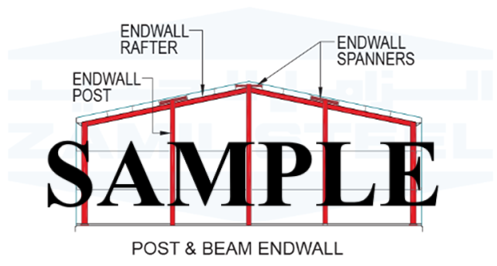
The key parameters of the building are summarized in the table below.
Table 1 Geometric parameters of PEBs
|
Length |
zzz m (10 @ 10m) |
|
Width |
zzz m |
|
Eave height |
zzz m |
|
Roof slope |
|
|
Roof purlins |
simple @1.325 m c/c |
|
Roof sheeting |
sandwich panel 0.1 kN/m2 |
|
Wall girts |
simple @1.6m c/c |
|
side cladding sandwich panel |
0.1 kN/m2 |
In this comparison, the same material definitions are used consistently in both MKAPEB and SAP2000 to ensure a fair comparison. The following material grades were used in the analysis:
Columns and Rafters: Structural steel with a yield strength of XXX MPa and an ultimate strength of XXX MPa. Elastic modulus is taken as XXX MPa, and Poisson’s ratio is assumed to be 0.3.
Purlins and Side Girts: Cold-formed steel sections with a yield strength of XXX MPa. These members are modeled as simple linear elastic elements without nonlinear effects.
Bracings: Round or flat steel members used for longitudinal and transverse bracing, with a material yield strength of XXX MPa.
All materials are assumed to behave elastically for the purpose of linear static analysis. No strain-hardening, material nonlinearity, or temperature effects are considered in this comparison.
In this comparison, the load values applied to the structure are calculated in accordance with ASCE/SEI 7-16,
using the load parameters defined for snow, wind, thermal, and seismic loads. These parameters are presented
in the respective tables in the following sections.
Table 2 The snow load parameters
|
Classification of Building |
I |
|
Terrain Category |
B |
|
Snow Surface Type |
Unobstructed Slippery Surfaces |
|
Exposure Type |
Fully Exposed |
|
Thermal Condition |
Ct=1 |
|
Ground Snow Load |
0.958 kN/m2 (20 PSF) |
Table 3 The wind load parameters
|
Wind Load Code |
ASCE-07-16 (Chapter 30) |
|
Building Class |
II |
|
Wind Exposure |
B |
|
Hurricane Prone |
No |
|
Wind Speed |
42.5 m/s (95 mph) |
|
Enclosure class |
Enclosed Buildings |
|
Cpi+ |
0.18 |
|
Cpi- |
-0.18 |
Table 4 The thermal load parameters
|
ΔT Summer |
20°C |
|
ΔT Winter |
-20°C |
Table 5 The seismic load parameters
|
Seismic Code |
AISC-07-16 |
|
Location on map |
Latitude: 34.05354; Longitude: -124.24529 (LA – California) |
|
Site Class |
C |
|
Site Description |
Very dense soil (360 to 760 m/s) (> 250 kPa) and soft rock |
|
Importance Factor (I) |
II |
|
Ss |
1.978 |
|
S1 |
0.705 |
|
PGA |
0.848 |
|
PGV |
0.924 |
|
Fa |
1.2 |
|
Fv |
1.4 |
|
Structural System |
C04 Steel ordinary moment frame |
|
Reduction factor (R) |
3.5 |
|
Overstrength Factor (Ω) |
3 |
Two sets of load combinations are considered in the design and analysis process: design loads and serviceability loads. In this study, the following design load combinations are utilized for the design phase. Here, D, L , Lr , S ,R ,W and E are dead, live, roof live, snow, rain, wind, and earthquake loads, respectively. Moreover, SDS indicates design earthquake spectral response acceleration at short periods.
1 1.4 D
2 1.2 D + 1.6 L + 0.5 (Lr / S / R)
3 1.2 D + 1.6 (Lr / S / R) + (L / 0.8 W)
4 1.2 D + 1.0 W + 1.0 L + 0.5 ( Lr / S / R)
5 (1.2 + 0.2 SDS) D + 1.0 E + 1.0 L + 0.2 S
6 0.9 D + 1.0 W
7 (0.9 + 0.2 SDS) D + 1.0 E
Additionally, the following load combinations are applied as serviceability load combinations.
1 1.0 D + 1.0 L
2 1.0 D + 0.5 S
3 1.0 D + 0.5 L + 0.7 W
5- COMPARISON OF ANALYSIS RESULTS
5-1- Support Reactions
5-2- Nodal Displacement
5-3- Member Internal Forces
5-4- Capacity Ratios
.
6- APPENDIX I
.